
Planning the acoustic performance of a space takes careful consideration across strategic placement and material selection. Because reverberation directly affects speech intelligibility, concentration and perceived loudness, architects and designers must choose the right amount of sound absorption when designing a space.
One metric commonly used to guide these decisions is the Noise Reduction Coefficient (NRC). NRC provides a standardized method for comparing materials' sound absorption performance and is widely used during specification.
While NRC plays a critical role in material selection, it is only one part of a broader acoustic design strategy. Effective acoustic design takes into account reverberation targets (RT60), room volume, surface coverage, mounting conditions and visual integration.
At Zintra, we believe that acoustic performance should not come at the cost of aesthetics and have developed innovative acoustic solutions that are as visually compelling as they are acoustically effective.
In this guide, we will cover how to choose the right NRC rating for optimal acoustic performance and what coverage requirements, mounting conditions, and room functions we recommend for acoustic solutions.
What NRC Actually Measures (Technical Breakdown)
Formal Definition
NRC rating is determined by a single number rating that represents the average sound absorption of a material across the four mid-frequency octave bands of 250, 500, 1000 and 2000 Hz. This is measured under the ASTM C423 absorption testing reverberation chamber and is a great way to compare material performance.
Because NRC is an average value, two materials with the same NRC can have vastly different performance outside of these octave bands. This is why the NRC should be used as a screening and comparison tool rather than a complete description of acoustic performance.
NRC vs Absorption Coefficient (α)
The absorption coefficient (α) looks at the proportion of incident sound energy and how it is absorbed in a specific frequency band. For example, α = 0.80 means the absorption coefficients at each frequency band are multiplied by the surface area coverage of the Zintra sound absorber to calculate the Sabins added to each surface in the room.
NRC vs SAA
Sound Absorption Average (SAA) is calculated by using 12 one-third-octave bands from 200-2500 Hz. Although it provides higher resolution, NRC still remains the industry standard for specification and comparison.
NRC vs STC
STC, or sound transmission between rooms, looks at how sound travels between spaces such as walls, floors, and partitions.
NRC and STC address fundamentally different acoustic problems:
NRC = sound absorption within a space
STC = sound transmission between spaces

NRC Rating Ranges (With Practical Interpretation)
NRC 0.00–0.10 → Highly Reflective Materials
Materials with an NRC of 0.00–0.30 are typically non-porous and reflect most incident energy. This contributes to flutter echo, poorer speech clarity and long RT60.
Examples: Glass, concrete, metal, painted drywall
NRC 0.40–0.65 → Moderate Absorption
When looking to acoustically balance a space, acoustic panels or materials with an NRC rating of 0.40-0.65 are often sufficient for corridors or low-occupancy spaces, but are not sufficient for open offices or learning environments.
Examples: Thin acoustic felts, low-density PET, standard ceiling tiles
NRC 0.70–0.95 → High-Performance Absorbers
When designing commercial spaces, choosing materials with an NRC acoustic performance of 0.75-0.95 is appropriate. These materials' thickness range from 12–25 mm and are typically enhanced with air cavities.
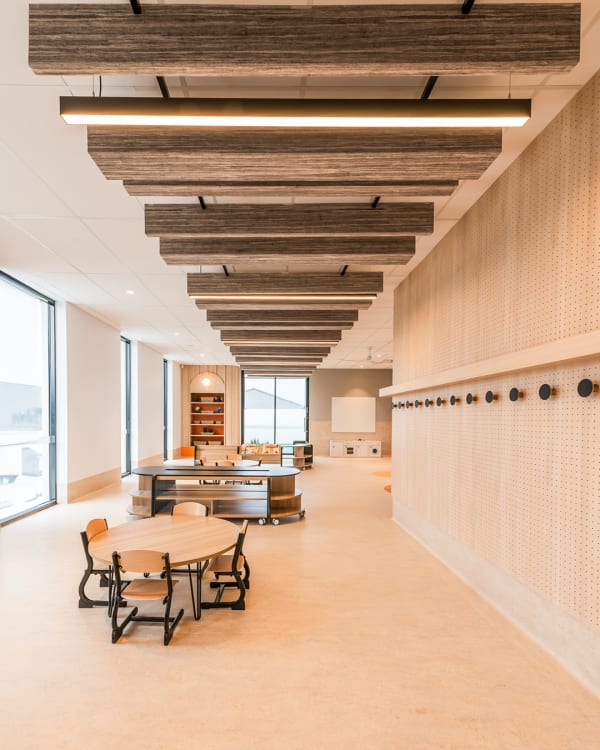
Examples: Zintra’s acoustic panels, acoustic baffles, and acoustic ceiling clouds are all high-performing absorbent materials that deliver outstanding acoustic performance.
NRC > 1.00 → Lab Condition Enhanced Values
NRC values over 1.0 happen when extended mounting or deep air gaps are tested in labs with ASTM C423. This can cause absorption to sit above 1.00 at certain octave bands due to edge effects, increased particle velocity or cavity resonance.
How NRC Influences Acoustic Outcomes in Real Projects
When choosing the right NRC ratings for commercial spaces, it is important to consider their relationship to reverberation time, speech intelligibility and perceived loudness:
Relationship to RT60 (Reverberation Time)
Reverberation time (RT60) is determined by the Sabine equation:
T60 = 0.161 × V / A
Where:
V = room volume
A = total absorption in Sabins
If you add 20 m² of material with NRC 0.85, you add roughly 17 Sabins. Meaning, whether that reduces RT60 depends on room size and existing absorption. This is why the NRC rating needs to be evaluated alongside coverage and volume context.
NRC and Speech Intelligibility (STI)
Speech energy sits between 100–3000 Hz (the fundamental frequency of most people is between 100-300 Hz, the higher harmonics of the human voice are from 300-3000Hz) , in line with the same octave bands that NRC ratings average within. With this in consideration, selecting materials with higher absorption for commercial spaces such as conference rooms, classrooms and healthcare facilities can reduce late reflections and improve STI.
NRC and Perceived Loudness
Although absorption does not reduce loudness, it reduces reverberant energy buildup, which can greatly determine how it feels to be in a space. Spaces with the right NRC treatment sound quieter, calmer and less fatiguing.


Step-by-Step Method to Determine the Right NRC for Your Project
Step 1 — Identify the Primary Acoustic Issue
To begin, determine what the primary acoustic issues are in the space.
Ask the questions:
Could the room size and existing absorption lead to excessive RT60 (lively, “boomy” room)?
Is there a flutter echo happening between parallel surfaces?
Does poor speech intelligibility happen?
Is there high distraction noise in open offices?
Once these questions have been determined, the functional requirements of the space can be determined.
Step 2 — Define the Functional Requirements of the Space
Each commercial space will have different needs and function differently.
We recommend the following for different spaces:
Open Offices
Target NRC: 0.75–0.90
Prioritize ceiling baffles or clouds
Treat ~35–60% of the ceiling area
Suitable Zintra acoustic panels, baffles, clouds
Classrooms
RT60 ≤ 0.6 s
Ceiling NRC ≥ 0.70 + selective wall absorption
Aligns with ANSI S12.60
Restaurants
NRC 0.70–0.90 depending on ambiance
Combine ceiling and wall treatments
Conference Rooms
NRC 0.75–0.95
Control early reflections near the table
Step 3 — Evaluate Room Volume, Geometry & Reflections
The size of the room, geometry and reflections all dictate the recommended NRC for commercial interiors. For example, larger room volumes require more Sabins for acoustic stability. Parallel hard surfaces can amplify flutter, and high ceilings increase decay time. The room size and geometry will also determine what type of sound absorption you can add.
Step 4 — Determine How Much Absorption You Can Add
When determining how much coverage is needed, we recommend treating 25-50% of the total wall and ceiling surface area. This is in line with Zintra’s Principle of 3, which suggests that for optimal absorption and acoustic performance, it is important to distribute absorption across different planes within a space. By breaking up reflections between opposing surfaces, sound is softened and controlled, resulting in a more refined and comfortable environment.
Step 5 — Select NRC Rating Based on Constraints
With areas with limited surface areas, we recommend an NRC of 0.85-0.95. If spaces have more generous coverage, an NRC of 0.60- 0.75 may suffice. Using integrated solutions such as Zintra’s acoustic panels, acoustic ceiling beams or acoustic ceiling clouds can add coverage without compromising on aesthetics and enhance performance.


How Mounting Type Affects NRC
The way a material was mounted during testing can greatly affect a material's measured NRC value. Because NRC is determined in a lab environment under controlled conditions, different ASTM C423 mounting types can create different absorption results, particularly at lower frequencies.
ASTM C423 Mount Types
There are many types of standardized mounting configurations, with the most common types being Type A and Type E:
Type A (direct mount): This is when the material is mounted onto a rigid backing surface, which typically results in reduced low-frequency absorption as there is no air cavity to enhance sound interaction.
Type E (air gap): This is when the material is mounted with an air gap between the panel and backing surface, improving absorption performance – especially at 250 Hz or lower frequencies.
Real-World Installations vs Lab Tests
Because the mounting type used in labs can affect the NRC rating, real-world applications can often perform differently from standardized lab setups. Factors such as wall studs, uneven substrates or installation variations can change acoustic performance.
In some cases, exposed edges or non-continuous mounting can increase effectiveness, while inconsistent backing conditions may reduce performance when compared to lab results.
Based on this, when determining the NRC acoustic performance, it should always be viewed in the context of the test mounting type and the intended installation method.
How to Verify NRC Claims
There are several ways to determine the NRC claims, as well as how to spot invalid ones.
Here is what to look out for:
What a Proper Test Report Includes
Accredited lab
ASTM C423 reference
Mounting type
Full octave-band coefficients
Sabins per unit and graphs
Red Flags to Avoid
NRC with no coefficient table
Identical NRC across many shapes
NRC >1.0 without a mount explanation
No test standard cited
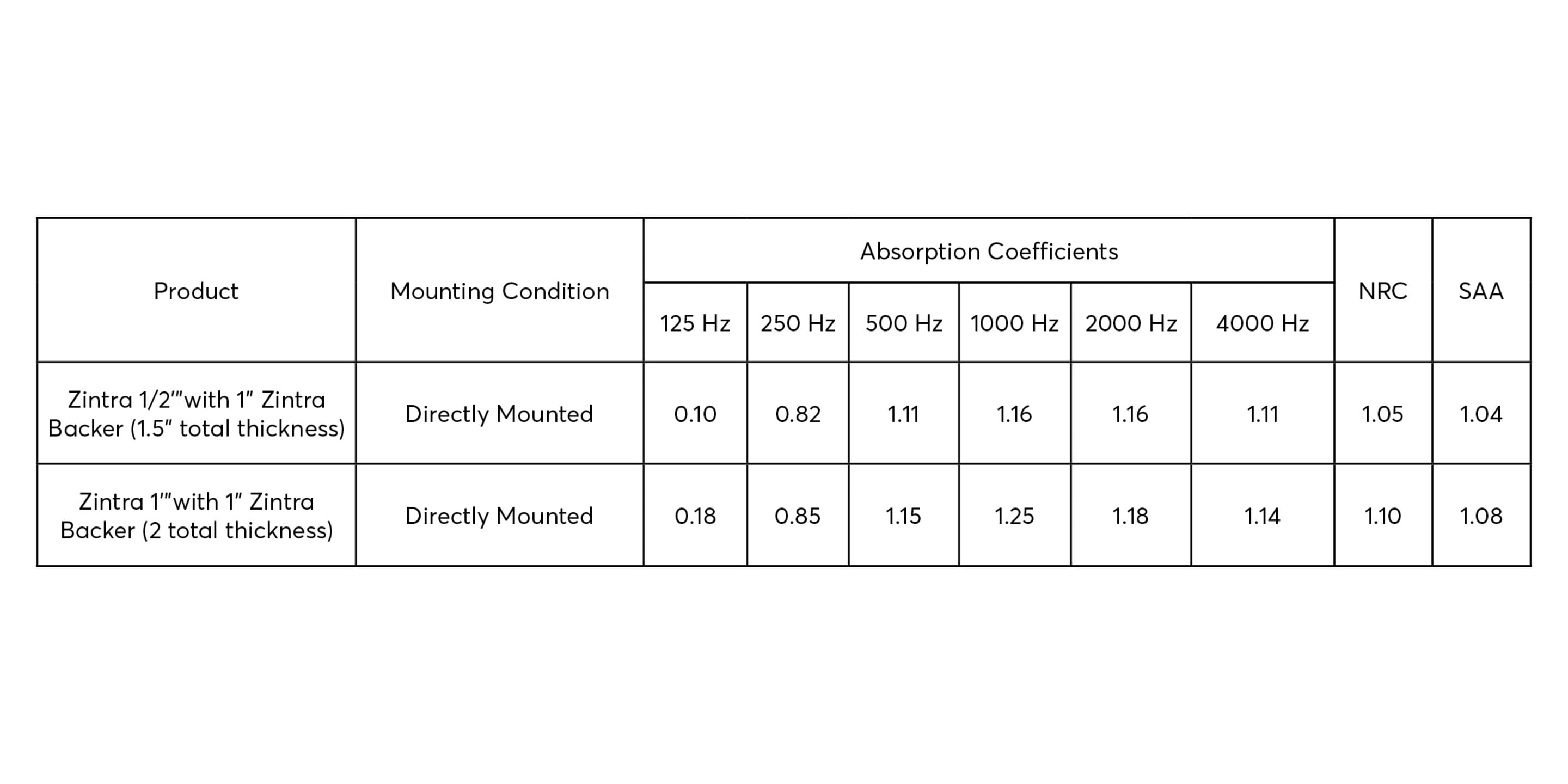
Example NRC testing: Zintra 1/2" and 1" Acoustic Panels

Aesthetic, Structural & Installation Considerations
Acoustic solutions should enhance, not detract from, the aesthetics of a space – creating cohesive environments where people feel comfortable and at ease. When selecting acoustic solutions for commercial spaces, the thickness, density, porosity and geometry of a material can all affect the NRC. With Zintra’s extensive range of acoustic baffles, ceiling clouds, acoustic tiles and acoustic wall panels, designers can reduce echo and add visual depth and interest to a space.
Zintra Acoustic Solutions
When it comes to selecting the right NRC rating for commercial interiors, it is not about choosing the highest number but rather finding the right balance for the space. This requires careful consideration of the space's function, RT60 targets, and what coverage, mount type and aesthetics are needed to achieve the desired acoustics and look.
By using Zintra’s principle of 3, designers and architects alike can deliver acoustically balanced spaces that support speech clarity, comfort and wellbeing. Zintra’s NRC-rated acoustic panels, acoustic baffles, acoustic ceiling clouds, acoustic ceiling beams, and acoustic tiles deliver optimal acoustic performance while maintaining design flexibility.
Ready to design acoustically balanced spaces? Explore our range or get in touch with our team of experts for specification support.